Freemasonry In Haiti | Digital Edition
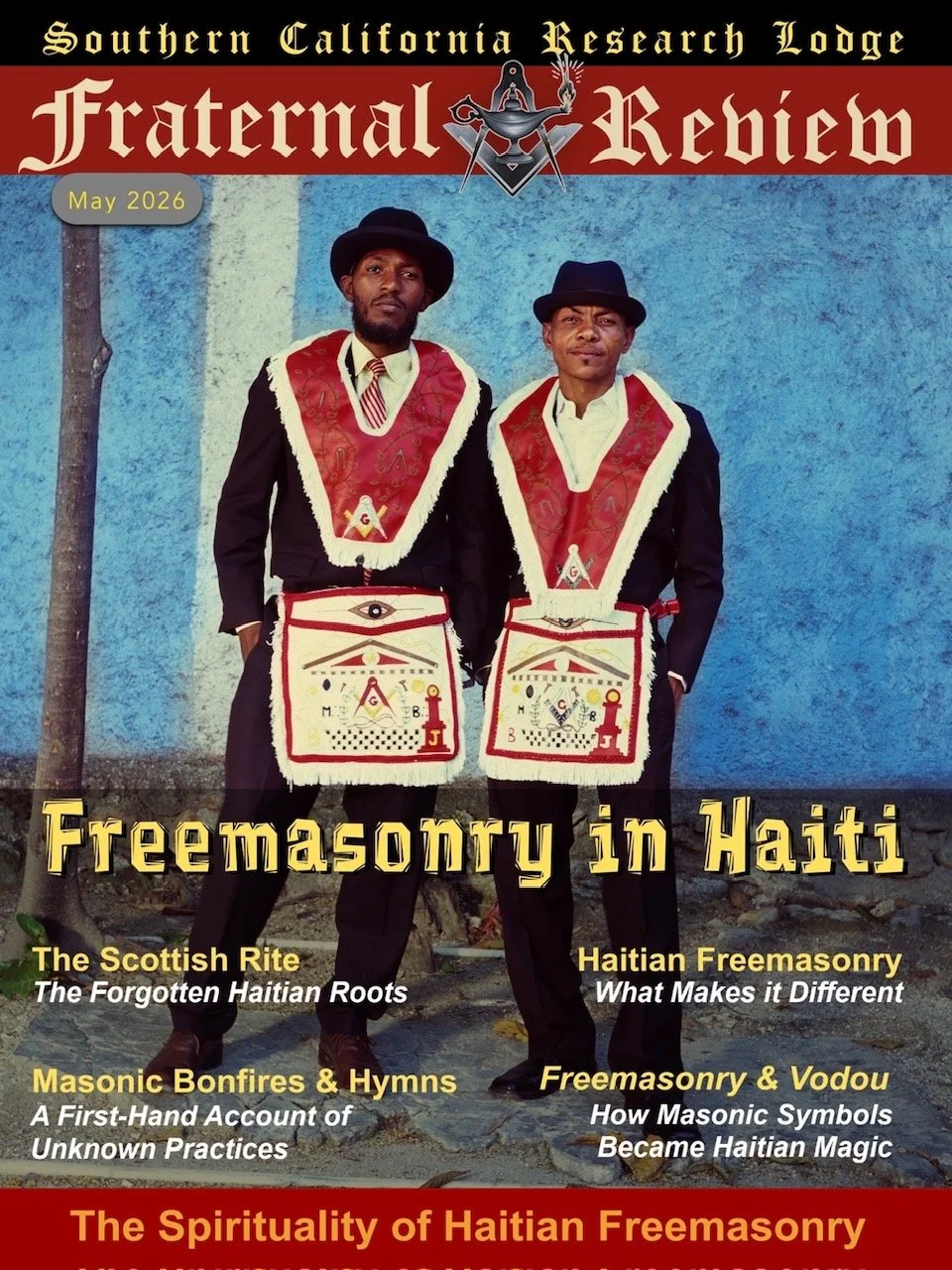
Freemasonry In Haiti | Digital Edition
Digital Edition | May 2026
My original intention for this issue had been to further explore some of the forgotten esoteric rituals and societies influenced by Freemasonry, such as I had in the Fringe Masonry I and II issues. After interviewing Leah Gordon and Katherine Smith, about their long-anticipated book Freemasonry in the Haitian Imaginary—recently published by Theion Publishing—I decided that the issue should focus solely on this subject.
In the English-speaking world—even in the USA—we know little of Haitian Masonic tradition, which is distinguished not only by certain practices (such as the singing of hymns, the burning of incense, and the lighting of ceremonial bonfires) but by the intentional cultivation of a spiritual (and not just fraternal) atmosphere.
Gordon and Smith kindly put me in touch with Jean-Daniel Lafontant and Masonic historian and Past Grand Master of the Grand Orient National d’Haïti, Dr. Gaétan Mentor, who contributed three articles to this issue. The first of these explores the Haitian Rite, its background, and its unique practices. The second focuses on the history of Freemasonry in Haiti. Lastly, Dr. Gaetan explores the Haitian roots of the Ancient and Accepted Scottish Rite.
Jean-Daniel Lafontant—an oungan, or Vodou priest—spoke to us about the influence of Freemasonry on Vodou. Often spelled “Voodoo,” this Haitian tradition has become associated with malefic occult practices (most obviously, “Voodoo dolls”), largely through popular, though sensationalist, movies.
While such movies may have misrepresented and stereotyped Vodou—influenced not only by Freemasonry but by Catholicism, African tribal religion, and the teachings of the native Haitians; the Arawaks—as a Masonic research journal, our aim is not to judge whether a tradition is good or bad, nor is it to promote it or critique it. Rather, it is to bring readers little-known information and new perspectives, and, as such, to enrich our understanding of Freemasonry, its history, and its historical influence.
From the adoption of the Square and Compasses to Masonic lwa (spirits), almost nothing about the significant influence of the Craft on Vodou is known in the English-speaking world, including among Freemasons. We hope this interview will be a valuable introduction to the subject.
I would like to express my thanks, not only to all of the contributors to what is quite possibly the first issue of an English-language Masonic journal dedicated to the subject of Haitian Freemasonry. My thanks also go to David Beth and Jessica Grote of Theion Publishing, for putting me in touch with Gordon and Smith, and for kindly allowing us to reproduce a small selection of photographs from Freemasonry in the Haitian Imaginary, taken by Gordon. While the articles and interviews shed light on Haitian history and practices, Gordon’s extraordinary images will give you a rare glimpse into what Haitian Masonic tradition actually looks like and, perhaps, feels like.
Fraternally,
Angel Millar
Editor-in-Chief
Due to the limited amount of hard copies printed, the single issues are only offered as digital downloads through our website.
Hard copies are only mailed to subscribers, or at times, sold by third party vendors.
2022 Hard Copy subscriptions our now closed.