Masonry and Fraternities | Digital Edition
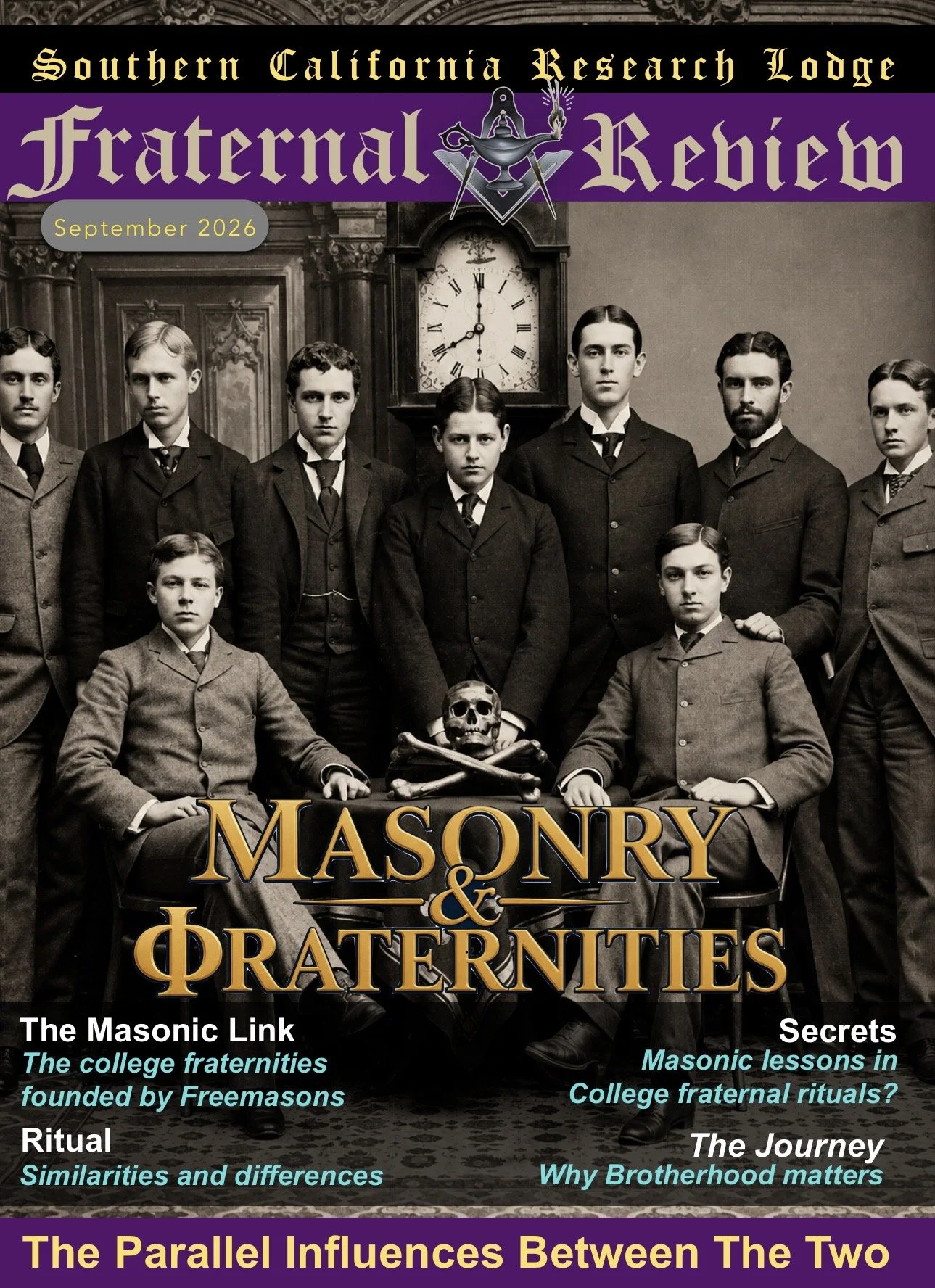
Masonry and Fraternities | Digital Edition
Digital Edition | September 2026
It is well known that Freemasonry is the oldest and largest fraternity on the planet, with rough estimates suggesting that there are about 900,000 regular Masons in the USA. Nevertheless, it is surprisingly common to meet people who are not familiar with Freemasonry. In contrast, it would
be challenging to find any adult in the states who is not familiar with a college fraternity or the Greek system generally. Collectively, college fraternities in our country have about 750,000 active undergraduate members and over 9,000,000 alumni. The largest college fraternities, Sigma Chi (ΣΧ) and Sigma Alpha Epsilon (ΣΑΕ), each have over 300,000 living members. Other top fraternities, such as Kappa Sigma (ΚΣ), Pi Kappa Alpha (ΠΚΑ), and Sigma Nu (ΣΝ) have over 200,000 living members each.
Freemasonry was influential on the development of college fraternities. Of the top 10 college fraternities, seven have direct connections to Masonry either through their founding members or the development of their rituals. Two Los Angeles Fraternities have direct relations Masonry to this day: Sigma Chi’s Kappa Omicron chapter, at Pepperdine University, holds its initiation ceremonies at Culver City Foshay Lodge No. 467; and, Sigma Nu’s Eta Phi chapter, at Cal State LA University, holds its initiation ceremonies at Lexington Lodge No. 104.
There are several ways that the both Masonic lodges and college fraternities are similar: they typically admit only men, admission is granted after an initiation ceremony, and they have similar
core values, principal tenets, great aims, etc. Their members are invested with a fraternity badge, granted esoteric knowledge of grips and words, and they engage in philanthropic efforts. Moreover, their systems of initiation lead men to hold themselves to higher standards and they create lasting connections of brotherhood affection throughout life.
This issue of Fraternal Review explores how many college fraternities were influenced by the Masonic fraternity, and compares similarities and differences between the two masculine orders. Two prominent Freemasons, Matthew Vander Horck, the current Grand Lecturer of Masons of California—a member of the Tau Kappa Epsilon fraternity, and John L. Cooper III, a Past Grand Master of Masons of California—a member of the Acacia fraternity, share about their first-hand experiences of being members of their college fraternities.
Of particular note, this issue also explores the shared Greek ancestry of Masonry and college fraternities, in Brother Tim Perez’s article, “Plato’s Allegory of the Cave.” A similar relationship is examined in an article on Phi Beta Kappa —the first Greek letter society, and one of the most prestigious honors societies in the country—by R. Stephen Doan, another Past Grand Master of Masons of California. Our point is that a Masonic spirit of Brotherly Love and affection has been shared among far more men in American history than those who are and were Freemasons.
Fraternally, Carrick Cheever, Guest Editor.
Due to the limited amount of hard copies printed, the single issues are only offered as digital downloads through our website.
Hard copies are only mailed to subscribers, or at times, sold by third party vendors.
2022 Hard Copy subscriptions our now closed.